At first, there was only silence — that heavy, empty kind that lingers after loss.
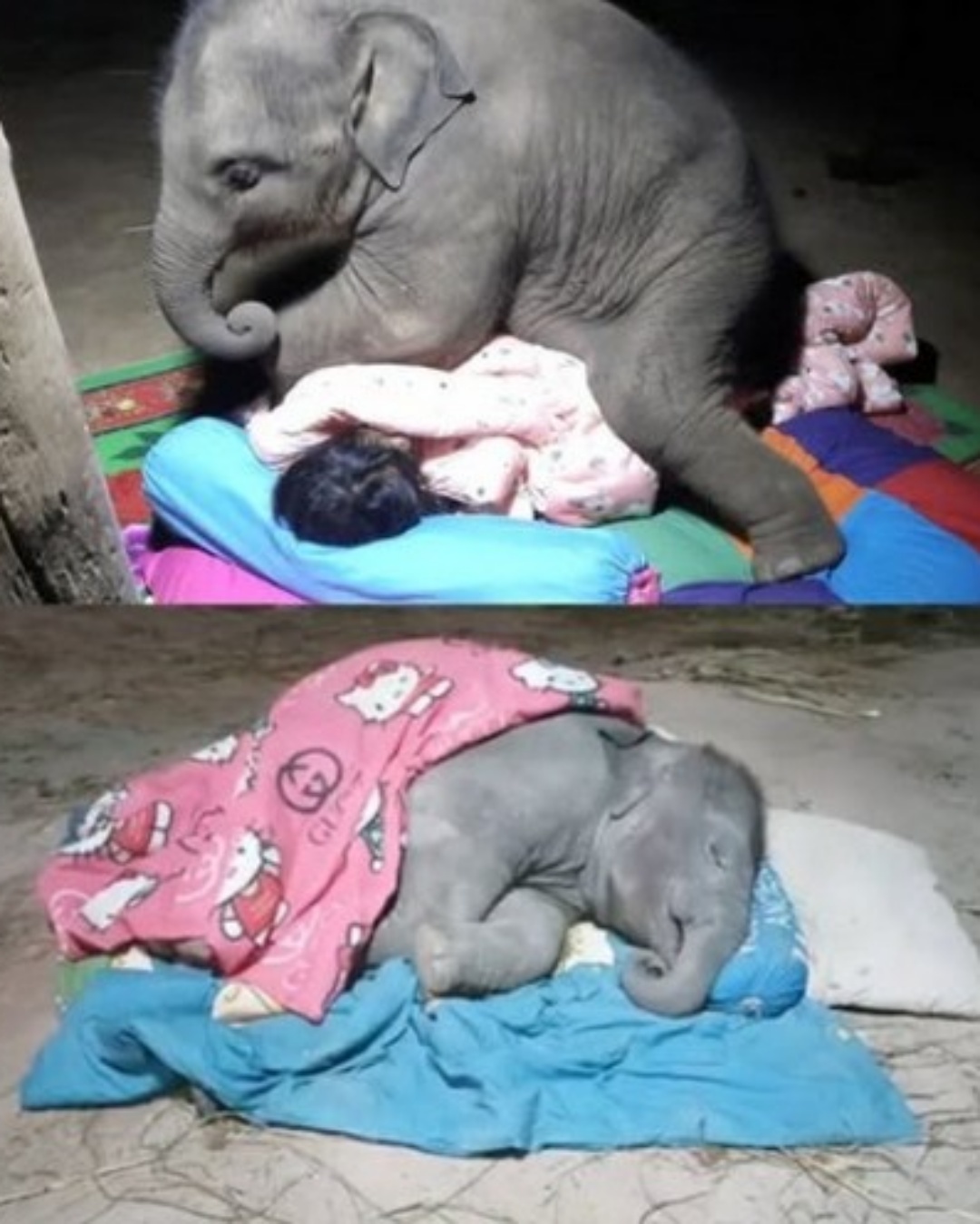
In the middle of a clearing, surrounded by the echo of the jungle, stood a baby elephant. His small frame trembled, his wide eyes searching for something that was no longer there.
His mother was gone.
Hours earlier, a gunshot had shattered the peace of dawn. A group of rangers had found her body soon after, tusks removed, a baby standing beside her, crying soundlessly — nudging, waiting, refusing to believe.
They called him Kavi, which means “poet,” because even in grief, there was a quiet beauty in the way he lingered by her side — lost, but loyal.
When the rescue team approached, he backed away, trunk flailing, eyes wide with terror. It took hours of gentle voices and careful steps before they could touch him.
And even then, his little body shook all the way to the truck.

At the elephant orphanage, Kavi didn’t eat for two days. He stood in the corner of his enclosure, facing the wall, his trunk hanging limp. The keepers tried everything — fruit, milk, fresh leaves, even lullabies.
But Kavi didn’t want food. He wanted her.
Elephant calves, much like human children, are deeply emotional creatures. They mourn. They remember. They ache. Without their mothers, they can die of heartbreak even before hunger.
The staff knew the danger. They had seen it before.
So they called in Meera, one of the most experienced caretakers in the sanctuary — a woman who had raised more than a dozen orphaned elephants over the years. Her presence was soft but sure, her movements deliberate, her voice a melody of calm.
When she first entered Kavi’s enclosure, he flinched. She didn’t try to touch him. Instead, she sat down in the straw and spoke softly — not in commands, but in the rhythm of reassurance.
Hours passed. She didn’t leave.
By evening, she had moved a little closer. Kavi’s ears twitched at the sound of her humming — an old folk song she used to sing to her own children.
When she finally reached out, he didn’t run.
He just stared at her hand, then slowly leaned forward — just enough to let his trunk brush her fingers.
It was a beginning.
Over the next few weeks, Meera became his constant.
She fed him bottles of warm milk every few hours, cleaned his wounds, walked him through the forest to help him learn to forage. But more than anything, she gave him presence.
Kavi followed her everywhere.
If she stopped, he stopped. If she knelt, he wrapped his trunk around her shoulder. When storms rolled in and thunder echoed across the plains, he pressed his small body against her legs, trembling until the sky quieted again.
And every night, Meera slept on a cot beside him. Sometimes, when he stirred in his sleep — trunk twitching, feet kicking — she would reach out, place her hand on his head, and whisper, “You’re safe, my boy. You’re safe now.”
Weeks turned into months, and Kavi began to change.
His eyes grew brighter. His steps more confident. He learned how to splash in the mud pits again, how to chase butterflies, how to trumpet — shyly at first, then proudly, startling the birds in the trees.
But what moved everyone most wasn’t his playfulness — it was his trust.
When Meera walked into the enclosure each morning, Kavi would run to her, trunk lifted high, trumpeting with joy. He’d nudge her pockets, knowing she always hid bananas somewhere. He’d curl his trunk gently around her arm, guiding her toward the water trough like a proud son showing off his toys.
“He follows her like a shadow,” one caretaker said. “She’s become his world.”
And maybe she had — but in a way, he had become hers, too.
For Meera, every orphan she’d cared for carried a story — of cruelty, survival, resilience. But Kavi’s story touched something deeper.
“He looked at me like he was asking why,” she once said. “Why did this happen? Why did love disappear so suddenly?”
It broke her heart because she had no answer — only a promise: that love, though lost, could be found again.
And so, she gave him that love every day — in her touch, her patience, her voice.
Slowly, Kavi began to mirror her calm. He learned that not every sound meant danger. That the world could be kind again. That trust, once shattered, could be rebuilt — not quickly, but surely.
The bond between them became legend within the sanctuary.
Visitors came from around the world to see them — the woman and the elephant who seemed to understand each other without words. Scientists studied their interactions; filmmakers captured their story.
But to Meera, it was simple.
“Kavi saved me, too,” she said one evening as the sun dipped low. “I came here to heal him — but he reminded me how to hope.”
She had lost her husband years before, and her own children had grown and moved away. Caring for Kavi filled that quiet space in her heart — the one only unconditional love can reach.
Together, they found something rare: healing born from shared loss.
One year after Kavi’s rescue, the staff decided it was time for him to join the older elephants in the open forest area — a crucial step toward independence.
Meera knew it was necessary, but the thought still ached.
That morning, she walked beside him one last time through the orphanage gates. The older elephants trumpeted from afar, their deep voices echoing like a welcome song.
Kavi hesitated. Then he turned, wrapping his trunk around her waist.
For a long moment, neither moved.
Meera rested her hand on his head, whispering, “Go on, my boy. You’re ready.”
He released her slowly — reluctantly — and took his first steps toward his new family.
She watched until he disappeared into the trees.
Months later, she visited the forest enclosure. The herd came running at the sound of her voice, and among them, towering and strong, was Kavi.
He was different now — bigger, bolder — but when he saw her, something in him remembered. He rushed forward, trumpeting, his massive trunk curling around her shoulders just as he had done as a calf.
And in that instant, the little orphaned elephant was gone — replaced by a giant who had learned, at last, that love could return.
Kavi’s story became one of hope — a reminder that even in the darkest corners of cruelty, compassion can still bloom. That trust, once broken, can be rebuilt one heartbeat at a time.
Because sometimes healing isn’t about forgetting loss.
It’s about finding someone who helps you carry it — until it feels lighter.
That’s what Meera did for Kavi.
And that’s what Kavi did for her.
In a world scarred by loss, their story whispers the same truth again and again:
Love, once given, never really leaves. It just changes form — sometimes into a memory, sometimes into a heartbeat, and sometimes into the soft trunk of a little elephant who learned to trust again.