“Goodbye, Mom…” — The Cry That Echoed Through the Forest and Touched the World
The dawn had barely broken when the forest fell silent.
No bird sang. No leaf stirred.Only the sound of soft, broken cries carried through the mist — a trembling voice calling for someone who would never answer again.
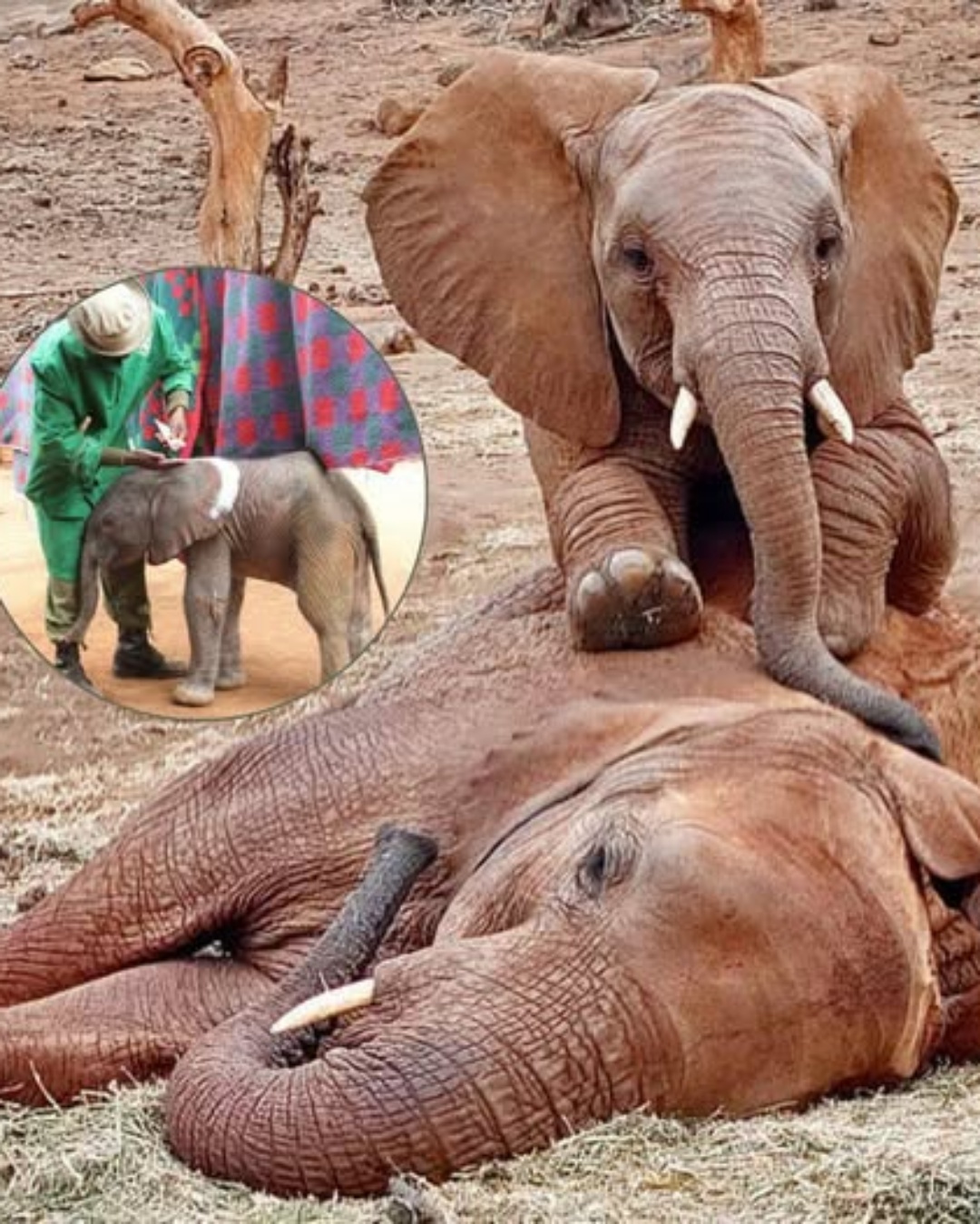
A young elephant calf stood beside his mother’s lifeless body, his trunk brushing her face as if trying to wake her.He didn’t understand why she wouldn’t move.
Why the air smelled of metal and smoke.
Why her eyes — the eyes that had once watched over him with such gentle strength — no longer blinked.
The poachers had come in the night.
They left behind only footprints, blood, and a child’s shattered world.

The Cry of Loss
For hours, he stayed there — nudging her, crying softly, refusing to leave.Each time he let out a cry, the sound rolled through the trees like thunder, echoing heartbreak that even the sky seemed to mourn.
Birds took flight; monkeys fell silent.
From afar, rangers at a nearby reserve heard it too — a sound no one ever forgets: the cry of a baby elephant who has lost his mother.
When they reached the scene, they found him still standing there, trembling, eyes wide with fear.He was just a few months old — too young to feed himself, too fragile to survive alone.
The rangers approached carefully, whispering soft words.
He didn’t run.
He simply looked up — as if asking, “Can you help me?”
The Rescue
They named him Kito, meaning “precious gift.”
It took hours to calm him.
He kept circling back to his mother’s body, touching her trunk one last time before the rangers gently led him away.Every step he took was heavy, his small feet pressing into the mud as though he was leaving behind his entire world.
At the rescue center, veterinarians worked quickly.
He was dehydrated, weak, and traumatized.For days, he refused to eat.
He’d stand in the corner of his pen, swaying gently — a motion elephants use to comfort themselves when grieving.
The caretakers didn’t give up.They spoke to him softly, mimicking the low rumbles of elephant mothers.
They brought him warm milk, blankets, and even a stuffed toy to rest against.
And little by little, something began to change.
The Gentle Hands of Hope
The first sign came one quiet evening.
As one of the keepers, Asha, sang to him in Swahili — the same lullaby she used for her own children — Kito reached out his trunk.He touched her arm, gently.
It was the first time he’d reached out to anyone since losing his mother.
That night, for the first time, he lay down to sleep.
From then on, Kito began to heal.
He learned to follow his caretakers to the feeding area, to drink milk from a giant bottle, to splash water playfully during bath time.The other orphaned elephants at the sanctuary slowly accepted him, and soon he wasn’t alone anymore.
Still, there were moments when grief returned — when he’d stand facing the horizon, lift his trunk, and let out a long, trembling cry that carried over the fields.The keepers knew what it meant.
He was calling for her.
And maybe, somewhere in the wind, she was still answering.
Learning to Live Again
Months turned into a year.Kito grew stronger, taller, his skin healthy again, his eyes brighter.
He loved splashing in the mud pit with his new elephant friends — Nala, Sefu, and Tamu.
He followed them everywhere, just as he once followed his mother.
When it was time for the herd to be reintroduced into the wild, Kito was among them.
The caretakers walked beside the elephants to the edge of the reserve — the place where captivity ends and freedom begins.
Kito paused for a long moment, trunk lifted to the air.
The scent of the forest drifted toward him — familiar and wild.
Asha placed a hand on his shoulder. “Go on, little one,” she whispered. “She’d want you to.”
And with one last rumbling sound — soft, deep, like a heartbeat — Kito stepped forward.
A Second Chance
In the months that followed, rangers occasionally spotted Kito and his herd moving gracefully through the grasslands.
He was thriving — strong, confident, no longer the trembling orphan they’d found beside the fallen matriarch.
He had become a leader, guiding younger calves, just as his mother had once guided him.
One evening, as the sun set over the plains, the rangers heard a familiar sound in the distance — a deep, powerful trumpet echoing through the trees.
It was Kito.
He was standing on a hill, silhouetted against the golden sky, his trunk lifted high.
Some said it was a call of triumph.
Others said it was a goodbye.
Maybe it was both — a way of saying, “I made it, Mom. I’m still here.”
✨ The Lesson of the Little Elephant
Kito’s story spread across the world, reminding millions of something we too often forget — that animals grieve, that they love, and that they feel loss just as deeply as we do.
His survival wasn’t just a victory for one life.
It was a testament to the power of compassion — to what happens when humans choose to care, to rescue, to rebuild instead of destroy.
Every time Kito takes a step through the forest, every time he trumpets to the sky, he carries with him the memory of a mother lost — and the love of the people who refused to let his story end in tragedy.
Because sometimes, the smallest act of kindness can save a life.
And sometimes, the loudest roar of hope comes not from a human voice — but from the heart of an elephant who learned to live again.